Florida does not issue a boating license, but anyone born on or after January 1, 1988 must carry proof of boating safety education to operate our pontoon. Here is exactly what that means for a Gulfport rental.
Florida Does Not Issue a Boating License
This is the question we field most often before a pickup at the Gulfport Municipal Marina. Florida does not issue a traditional boating license. There is no plastic card that works like a driver license, and there is no road test on the water.
What the state does require is documented boating safety education for a large slice of operators. That rule sits in Florida Statute § 327.395. It is triggered by your birth date, not by how many hours you have spent behind a wheel.
The distinction matters the moment you rent. A lifelong boater born in 1990 still needs the paperwork. Someone born in 1970 who has never touched a throttle does not, at least not under the education statute.
Our self-drive pontoon rental puts you in the operator seat, so the requirement lands squarely on you. Sort it out before your rental date and dockside check-in takes minutes instead of an hour.
Nothing below replaces the official text. It is the plain-English version we give renters standing on the dock with a cooler in one hand and a phone in the other.
One more thing worth clearing up early. The education requirement is a state rule and it does not depend on where in Florida you rent. Gulfport, Clearwater, and the Keys all apply the same standard.
It also does not care whether the boat is yours or ours. A visitor borrowing a friend's pontoon faces the identical requirement, which surprises people every summer.
The 1988 Rule and Who It Covers
Here is the line that decides it. Anyone born on or after January 1, 1988 must carry proof of boating safety education to operate a vessel powered by a motor of 10 horsepower or greater in Florida.
Every pontoon we rent exceeds 10 horsepower. There is no version of our boat that falls under that threshold, so the rule applies to every self-drive trip we send out.
Proof means one of two things: a temporary certificate or a permanent Florida Boating Safety Education ID Card. Both are covered further down. Either one satisfies the statute, and both need to be on you while you are running the boat.
The statute also writes in a short list of exemptions. You do not personally need the education credential if any of these apply:
- You are accompanied by a qualified operator who is 18 or older and who meets the education requirement.
- You are a non-resident who holds an equivalent NASBLA-approved boating course credential from another state.
- You are operating within 90 days of completing an approved boating safety course.
Read that first exemption carefully, because renters misread it constantly. The qualified operator has to be aboard with you, not waiting back at the dock in Gulfport.
Operators born before January 1, 1988 are outside the education requirement entirely. Our own age policy still applies to them, and that policy is stricter than the statute.
Florida issues no boating license. What the state asks for is proof of safety education, and only from operators born on or after January 1, 1988.
The 90-Day Temporary Certificate Most Renters Take
Almost everyone renting a boat for a vacation week takes the temporary route. It exists specifically for renters, and it is the fastest legal path to the helm.
The temporary certificate is valid for 90 days. Most people finish the online material and the test in 30 to 60 minutes. The certificate issues instantly when you pass, and the whole thing works on a phone, so you can knock it out on the flight down or in the parking lot.
Take it before your rental day rather than on it. A weak cell signal at the marina is a bad place to discover you still have twenty questions left.
These are FWC-approved vendors for the Florida temporary certificate:
- BoatUS Foundation - Florida temporary boater certificate
- Boat Ed - Florida rental boater course
- Ace Boater - Florida boat rental certificate
- FWC - full list of approved providers
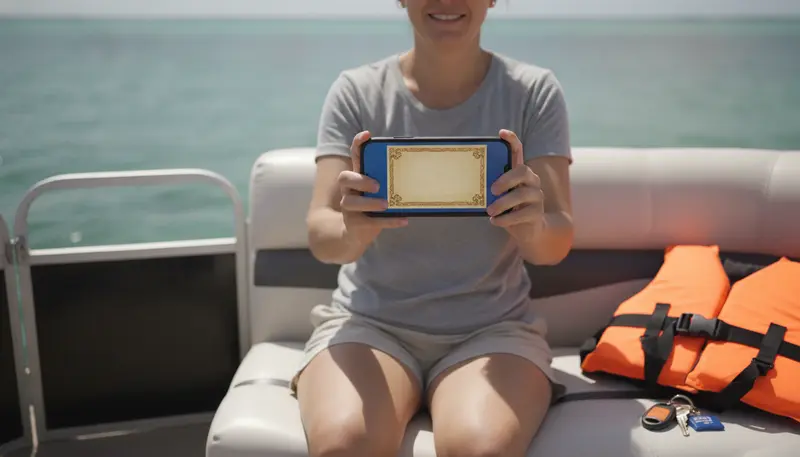
Save the certificate to your phone and screenshot it. Signal drops in spots around the bay, and a screenshot does not care whether you have bars.
If several people in your group plan to trade off at the wheel, each of them needs their own credential. The certificate belongs to a person, not to the boat.
The Permanent Boating Safety Education ID Card
The permanent option is the Florida Boating Safety Education ID Card. You earn it by completing a full FWC-approved boating safety course rather than the abbreviated rental exam.
The course covers more ground: navigation rules, aids to navigation, required safety equipment, emergency procedures, and Florida-specific regulations. It takes longer than the temporary test, and that is the point.
The card does not expire. If you rent in Florida more than once every few months, it is the better investment. Renters who come back to Pinellas County every spring stop repeating the temporary exam once they have it.
It is also the credential we most like to see on a first-time renter of a bigger boat. Nothing about the temporary exam is trivial, but a full course leaves people noticeably more comfortable reading channel markers.
Details on our 2026 TriToon pontoon help you decide which route fits. The boat seats 11 passengers with a 1,610 pound limit, and moving a loaded pontoon through a busy channel rewards a real course.
Either credential is equally valid at our dock. We are not grading you on which one you chose.
One practical note on the full course. The material spends real time on right-of-way and on what the different markers mean. That knowledge pays off the first time you meet a larger vessel in a narrow channel.
Our Age Policy and What Happens at Check-In
Company policy is stricter than state law on one point, and we do not bend it. The operator must be 21 or older, regardless of birth year.
That means a 19-year-old who holds a valid temporary certificate still cannot run our boat. It also means a 58-year-old with no education requirement at all clears the age rule automatically.
Bring a valid photo ID to check-in. We verify the name on the ID against the name on the reservation and against the boating safety credential when one is required.
Check-in at the Gulfport Municipal Marina is where the paperwork gets confirmed and where we walk you through the boat. We cover the controls, the throttle feel, docking, and the no-wake zones you hit on the way out.
If the paperwork does not clear, the trip does not leave the dock. That is a miserable outcome for everyone, and it is entirely avoidable with ten minutes of prep.
Nothing changes for guests driving over for our boat rentals in St. Petersburg, because the education requirement is statewide and identical from one city to the next.
Handle the credential early, bring the ID, and the rest of check-in is the fun part.
Hiring a Captain Removes the Question Entirely
There is a second route, and plenty of groups take it. Book the bareboat rental with a captain and the education requirement stops being your problem.
The structure is worth understanding. You hire an experienced freelance captain directly from our published roster. You pay that captain directly on the day of the rental, and gratuities are appreciated.
Our list of freelance captains for hire shows each captain and their contact number. You contact whoever you want and arrange the day with them yourself.
Groups pick this for a few honest reasons. Nobody aboard has ever driven a boat. Everyone wants a cold drink without one person staying dry all afternoon. Or the group is new to the area and wants someone who already knows where the good anchorages sit.
Local captains also read the water faster than a visitor can. They know which channels shoal, where the no-wake zones start, and how the afternoon chop builds in summer.
Both routes get you the same boat on the same day out of the same slip. One asks you to do 30 minutes of homework first. The other asks you to make a phone call.
If your group is undecided, book early and settle the captain question after. Captains are freelance and the good weekend slots go fast in season.
Still not sure which route fits your group? Call or text us at (813) 445-7223 and we will talk it through, or plan your trip from our Gulfport dock and we will follow up with the details.
Frequently Asked Questions
Do I need a boating license to rent a pontoon boat in Florida?
No. Florida does not issue a traditional boating license, so there is nothing to apply for at a state office.
What you may need is proof of boating safety education. If you were born on or after January 1, 1988, you must carry that proof to operate a motor of 10 horsepower or greater. That threshold covers every boat in our Tampa Bay pontoon rental lineup.
How long does the Florida temporary boater certificate take?
Most renters finish in 30 to 60 minutes. The course and exam are online, mobile friendly, and the certificate issues instantly when you pass.
It stays valid for 90 days, which covers a vacation rental comfortably. Save it to your phone and take a screenshot as backup.
I was born before 1988. Do I still need anything?
The boating safety education requirement in Florida Statute § 327.395 does not apply to you. You do still need a valid photo ID at check-in.
You also still have to meet our company age policy, which requires the operator to be 21 or older no matter the birth year.
Does everyone on the boat need boating safety education?
No. The requirement attaches to whoever is operating the vessel, not to passengers along for the ride.
If two or three people plan to trade off at the wheel during the day, each of those operators needs their own credential and each must be 21 or older.
What if I took a boating course in another state?
A non-resident holding an equivalent NASBLA-approved course credential from another state is exempt. Bring the card or certificate with you to check-in so we can verify it.
The same goes if you are operating within 90 days of completing an approved course. Our boat rentals in Gulfport all depart from the same marina, and the credential check happens right at the slip.